From Bone Realignment to Ortho-Plastics Limb Salvage: My CMT Foot Reconstruction Journey
Damien Harrison
CMT Patient & Advocate
Living with Charcot-Marie-Tooth (CMT) disease slowly changed the shape of my feet. This is the full story of my reconstruction: from the first surgery to realign my bones, through a serious infection, to a second operation that saved my foot.
- 1. Living with CMT and Choosing to Save My Joints
- 2. Act 1 (March 2026): The First Reconstruction
- 3. The Complication: A Wound That Would Not Heal, and a Bone Infection
- 4. Act 2 (August 20, 2026): Saving the Foot, and Anaesthesia Built for CMT
- 5. The Recovery: Antibiotics, Rest, and the Right Nutrition
- 6. What I Want the CMT Community to Take From This
- Key Takeaways for the CMT Community
- Further Reading & Medical Context
1. Living with CMT and Choosing to Save My Joints
Living with Charcot-Marie-Tooth (CMT) disease has meant slowly losing feeling and strength in my legs and feet. Over the years, the muscles in my lower legs wasted away at different rates. Because some muscles were weaker than others, they pulled my foot bones out of place. My feet developed cavovarus deformities, very high arches, toes that curled under, and ankles that kept giving way. Walking became painful and unpredictable, and I was falling more and more often.
When things got bad enough, my surgeon gave me a choice between two operations. The first was to fuse the joints in my foot together so they could not move. This stops the pain, but it also makes the foot completely stiff. The second was to rebuild the foot and keep the joints moving. I chose to keep my joints moving, for three reasons:
- Keeping my foot flexible: I wanted my hindfoot and midfoot to keep bending naturally, so I could walk with a normal, shock-absorbing gait.
- Protecting my other joints: Fusing joints in my foot would push extra stress onto my ankle and the rest of my foot, wearing them out faster and causing arthritis sooner.
- Staying active long-term: Re-balancing the muscles that were still working gave me the best chance of an active, moving foot, rather than a stiff post.
Choosing to rebuild rather than fuse was not without risk. CMT damages the nerves and blood supply that help wounds heal, so my tissue was more fragile than most. This post shares the whole journey: the first reconstruction, the wound that broke down and became infected, and the second operation that saved my foot.
2. Act 1 (March 2026): The First Reconstruction
In March 2026, I had a major, multi-part reconstruction under my orthopaedic surgeon, Mr. Anjum Rashid. The plan was to take apart my misshapen foot, rebuild a solid base, and re-balance the muscles pulling on it.
| Procedure | What it did and why |
|---|---|
| Achilles Lengthening | Lengthened my tight Achilles tendon so my heel could sit flat on the ground. |
| Calcaneal Osteotomy | Cut and shifted my heel bone to straighten the inward tilt of my hindfoot. |
| Tendon Transfers | Moved working tendons to new positions so they could do the job of muscles that CMT had paralysed. |
| Jones Procedure | Eased the overload on the front of my foot and straightened my clawed toes. |
Straight after surgery, the change was dramatic. Mr. Rashid had straightened my heel and corrected my clawed toes, leaving my foot in a neutral, flat position. At first, the wounds on the side of my calf and midfoot seemed to be closing well, before the problems began.
3. The Complication: A Wound That Would Not Heal, and a Bone Infection
CMT does not just weaken muscles. It also damages the tiny nerves and blood vessels that keep skin healthy, which makes the soft tissue around the foot fragile. Months into my recovery, the skin over the side of my heel started to break down. The surgical wound opened up into a deep, raw sore.
That opening reached all the way down to my heel bone. Bacteria got in and infected the bone itself, a condition called osteomyelitis. By August 6, 2026, the area was badly inflamed, the wound kept weeping, and the bone was involved, so I was readmitted to hospital as an emergency.
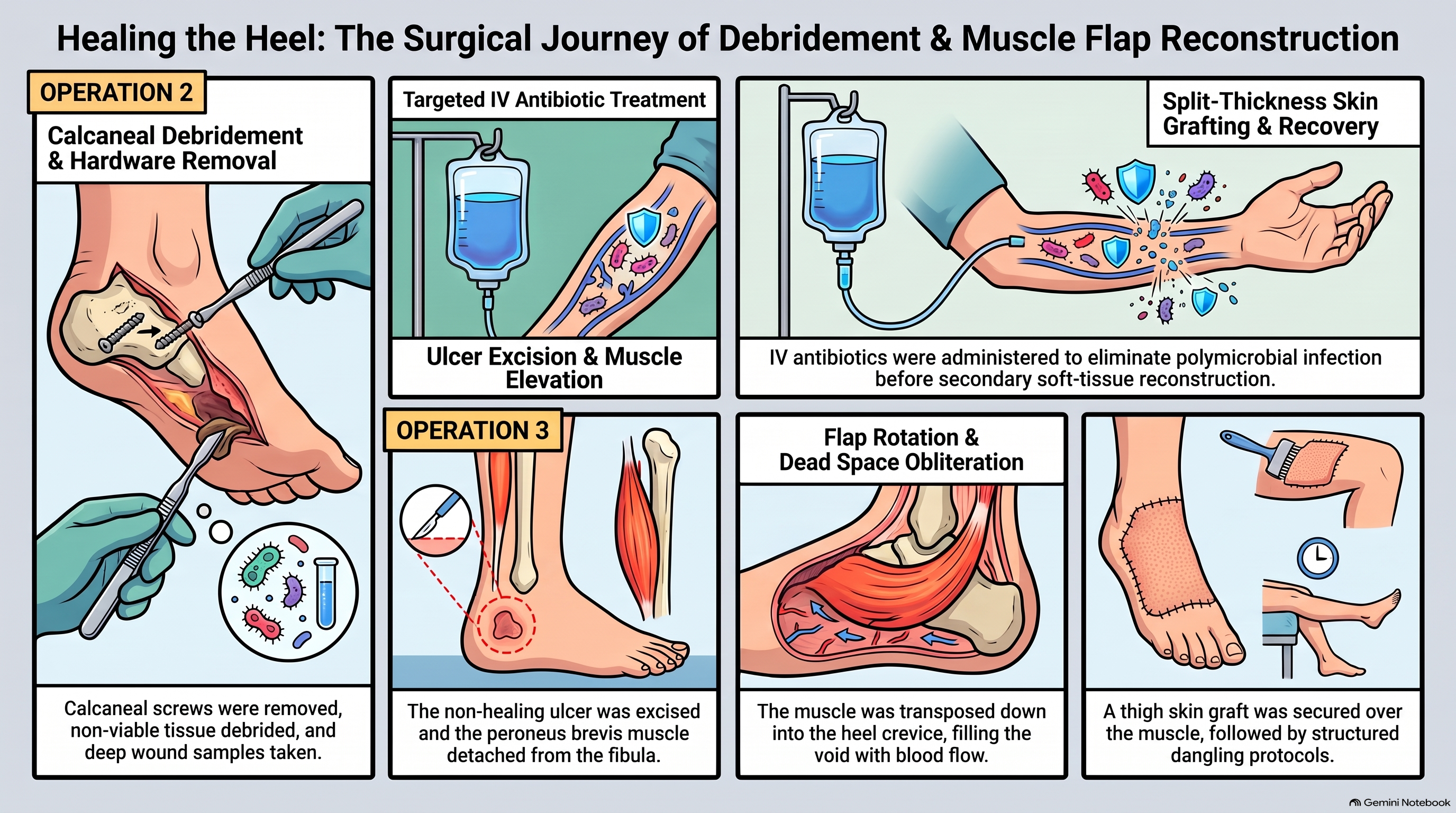
I went back to theatre for a thorough debridement, the team cleaned out all the dead and infected tissue, scraped the infected heel bone, and removed the metal screws and plates that had become a hiding place for bacteria. Lab tests from deep inside the bone found a mixed infection of several different bacteria:
- Staphylococcus aureus
- Streptococcus constellatus
- Corynebacterium striatum
- Enterobacter cloacae
4. Act 2 (August 20, 2026): Saving the Foot, and Anaesthesia Built for CMT
On August 20, 2026, plastic surgeon Mr. Mohamed Abdelrahman carried out the operation that saved my foot. Cleaning out the infected heel bone had left a deep gap. To fill it, he used a peroneus brevis muscle flap. He took a muscle from the side of my lower leg, swung it down on its own blood supply to fill the hole in my heel, and covered it with a thin skin graft taken from my thigh.
Having major reconstructive surgery when you have CMT is not the same as for everyone else. Because my nerves and muscles work differently, my anaesthetic had to be carefully planned:
- Avoiding gas anaesthesia (using TIVA instead): I was kept asleep using a drip of medication (Total Intravenous Anaesthesia, or TIVA) rather than the usual anaesthetic gases. Because CMT has wasted my muscles and changed how they respond, gas anaesthetics can cause dangerous reactions, so they were avoided altogether.
- Staying away from strong opioids: Strong painkillers like oral morphine (Oramorph) were left out. In CMT, the weakness can affect the breathing muscles, and opioids can push that weakness further, making it hard to breathe. Instead I had a mix of non-opioid pain relief.
- Careful blood-thinner timing: I take Apixaban every day because of my history of blood clots. The team had to stop and restart it at exactly the right times, stopping it long enough to avoid dangerous bleeding under the new muscle flap, but not so long that I was at risk of another clot.
- Watching my temperature and blood pressure: People with CMT can react unpredictably to a general anaesthetic. The team was ready for my blood pressure to drop, for me to take a long time to wake up (often over six hours), and for me to get very cold afterwards. They had warming blankets ready and an intensive care plan on standby just in case.
| Standard approach | My CMT-adapted version, and why |
|---|---|
| Anaesthetic gas | TIVA (a drip instead): Avoids the unpredictable muscle reactions that gas can cause in CMT. |
| Strong opioids (e.g. Oramorph) | Non-opioid pain plan: Protects my breathing muscles from being depressed further. |
| Standard recovery monitoring | Extended recovery / ITU on standby: Ready for low blood pressure, slow wake-up, and low temperature. |
| A simple pause of blood thinners | Precision Apixaban timing: Balanced the risk of bleeding under the flap against the risk of a new clot. |
5. The Recovery: Antibiotics, Rest, and the Right Nutrition
Closing the wound was only the start. To clear the infection deep in the bone, I first had strong antibiotics through a drip, then stepped down to high-dose oral Ciprofloxacin and Linezolid, chosen because they penetrate bone well and target the bacteria the lab had found.
To protect the new muscle flap, my leg had to stay completely still in a rigid boot and be kept raised above heart level to stop blood pooling. Before I could stand, the team used a Dangle Protocol. This means lowering my leg over the edge of the bed for a little longer each time, so the new tissue slowly gets used to the pressure of gravity without damaging its delicate blood supply.
To help my body repair the tissue, rebuild bone, and support my nerves, I stuck to a targeted supplement routine:
- Whey protein isolate & HMB: To hold on to my muscle while I could not bear weight, and stop my body breaking itself down.
- Collagen peptides + Vitamin C: To help build the collagen needed to heal the flap, the skin graft, and the incisions.
- Zinc: To support cell repair and local immunity.
- Vitamin B12 (low-dose B-complex): For nerve-supporting B-vitamins, while carefully avoiding high-dose B6, which can worsen CMT nerve damage.
- Calcium citrate: An easy-to-absorb form of calcium to help my heel bone re-mineralise after the osteotomy and the infection. I chose citrate over carbonate because it absorbs well without needing lots of stomach acid and is gentler on the gut.
6. What I Want the CMT Community to Take From This
Going through all of this taught me how important it is to speak up for yourself. CMT is rare, and hospital teams do not always know the details. You have to tell them, clearly, about the things that matter for you, your sensitivity to opioids, the way your nerves react, and exactly how you need your anaesthetic handled, at every stage of your care.
Mental endurance matters just as much. I have practised yoga and breathwork for 14 years, and that was an anchor during long stretches in bed, painful dressing changes, and the uncertainty of it all. Slow, steady breathing helped me ride out the worst pain spikes and feel in control during stressful moments.
Today, my heel has healed, the bone infection has cleared, and my foot is in a stable, flat position. Now the focus shifts to rehab and getting back to moving properly.
Key Takeaways for the CMT Community
- Speak up for yourself: Never assume a hospital team knows the subtleties of CMT. Tell every doctor and nurse about your anaesthetic preferences, your opioid sensitivities, and how fragile your nerves and blood supply are.
- Build your mind before you need it: Practising breathwork and mental calm long before surgery gives you something real to lean on during severe pain, surprises, and long stretches of being stuck in bed.
- A rebuilt foot is still possible after serious complications: Even when a wound breaks down and the bone gets infected, combining bone realignment with reconstructive plastic surgery can save a moving foot, instead of fusing it stiff or losing it.
Further Reading & Medical Context
For deeper clinical context on managing complex foot reconstruction and infection in neuromuscular disease, explore these authoritative resources: